Side Hustles
How to Write Etsy Product Descriptions With ChatGPT (Free, Step by Step)
Write keyword-optimized Etsy product descriptions with ChatGPT for free. Copy-paste prompts for titles, tags, and descriptions you can fact-check before publishing.
Correction, October 10, 2026: The earlier version claimed the first 40 title characters carried extra ranking weight. Etsy says keyword position in titles does not affect ranking. The prompts and examples below now reflect that guidance.
Most Etsy descriptions are written twice. First the seller bangs out something at 11pm before going to bed. Then, six months later, they rewrite it after realizing the listing never showed up in search.
You can skip the first version. ChatGPT, on the free plan, will write a keyword-front-loaded title, a 13-tag set, and a description that reads like a human wrote it – if you feed it the right brief. That last part is where almost everyone fails. They paste “write me an Etsy description for a candle” and get back 200 words of lavender-scented filler that mentions “in today’s busy world.”
Here is a brief-first workflow, with prompts you can adapt. No paid tools required, though I’ll point out where one helps.
First, understand how Etsy search actually works
Before you touch ChatGPT, three Etsy facts shape every prompt below.
Lead with clarity, not a supposed ranking bonus. Etsy says the position of a phrase in a title does not affect ranking. Put the product name early so shoppers can understand it when the title is shortened in search results. There is no special first-40-character ranking rule.
You get 13 tags, each up to 20 characters. Use all 13. Etsy recommends relevant, varied multi-word phrases such as “dog mom gift.” Use the available tags to describe the item accurately; filling a slot with an irrelevant term does not help.
Descriptions help Etsy match relevant searches. Etsy recommends incorporating relevant keywords naturally in the first few sentences. That is guidance for useful copy, not a guarantee of a ranking position. See Etsy’s keyword guidance for the current rules.
ChatGPT does not know your specific shop’s data, and it will happily invent “best-selling” claims that aren’t true. You are the editor. It is the intern.
Step 1: Give ChatGPT a real product brief
Garbage in, lavender filler out. The single biggest quality jump comes from describing the product properly. Open ChatGPT and start with this.
You are an Etsy SEO specialist. I sell handmade and print-on-demand products. I’m going to describe a product, and you’ll help me write the listing. First, just confirm you understand these Etsy SEO rules: titles should clearly identify the product, without a special ranking bonus for keyword position; I have 13 tags of up to 20 characters each and want multi-word phrases; the description’s first two sentences should contain the main keyword naturally; no keyword stuffing. Reply “ready” and ask me for the product details.
Make it confirm the rules back. This primes the model and catches the version of ChatGPT that ignores half your instructions.
Then give it the brief:
Product: [what it physically is, materials, size, colors]. Made by: [handmade by me / print-on-demand]. Buyer: [who buys this and the occasion]. Vibe: [funny / minimalist / cottagecore / etc.]. Main keyword I want to rank for: [your best guess]. Three competitor listings I like: [paste 2-3 titles you found on Etsy].
That last line – pasting competitor titles – is the cheat code. ChatGPT can suggest patterns to investigate. Competitor titles do not prove search demand, and you should not copy their claims.
Step 2: Generate the keyword set first
Don’t write the description yet. Get the keywords sorted, because everything downstream depends on them.
Based on my product, generate a keyword map: (1) one primary keyword for the title, (2) five secondary long-tail keywords buyers would actually type into Etsy search, (3) thirteen tags, each 20 characters or fewer, all multi-word phrases, no duplicates, no single words. For each tag, note whether it targets the product, the occasion, or the buyer. Don’t repeat the same root word in more than 4 tags.
That last constraint matters. Left alone, ChatGPT will give you “dog mug, dog mom mug, dog lover mug, dog gift mug” – four near-identical tags wasting four slots. Forcing variety across product/occasion/buyer angles is how you cover more searches.
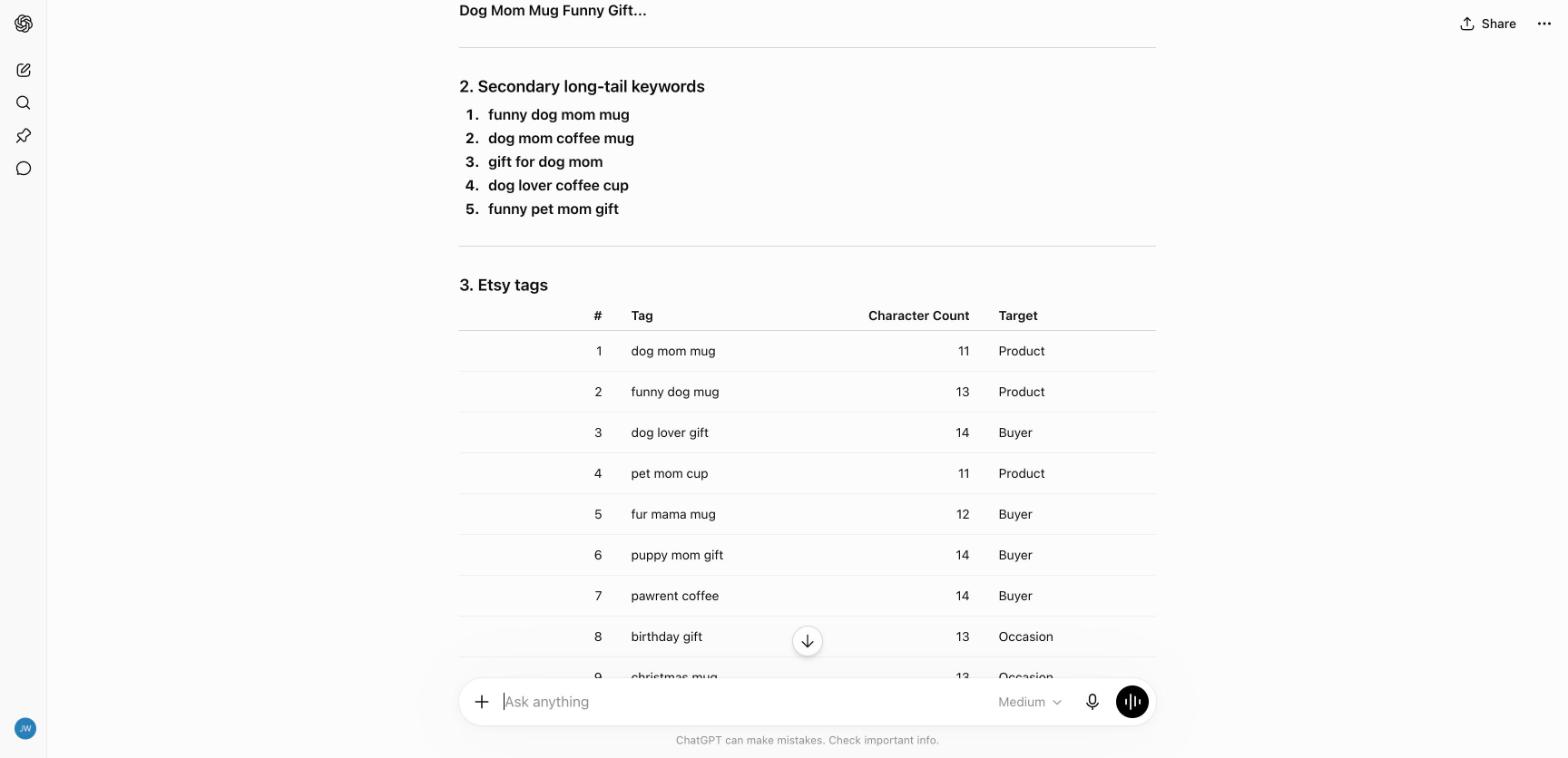
Use Etsy’s autocomplete to explore wording, then check your own shop’s search-term and listing performance data. A missing autocomplete suggestion does not prove nobody searches for a phrase. ChatGPT’s keyword ideas are hypotheses, not measured Etsy search volumes.
Step 3: Write the title
Now the title, using the locked-in keywords.
Write 3 Etsy title options. Rules: under 140 characters, clearly identify the product early, include relevant distinguishing details, avoid repetitive keyword lists, readable to a human, no ALL CAPS, no emoji. Explain what a shopper can learn from each title.
Good vs bad title output
Bad (what you get from a lazy prompt): “The Perfect Gift for Any Occasion - Beautiful Handmade Ceramic Mug for Coffee Lovers and Tea Drinkers”
The shopper has to read through vague gift language before finding out what the item is.
Clearer: “Personalized Dog Mom Mug, 11oz Ceramic Cup”
This identifies the product and an example size quickly. Use the size only if it is true of your product. A clearer title can help shoppers decide whether to click; it cannot promise a ranking position.
Step 4: Write the description
Last, the description – and this is where you give the most specific instructions, because the default ChatGPT description voice is recognizably robotic.
Write an Etsy product description. Structure: (1) First two sentences must include “[primary keyword]” naturally and describe what the product is and who it’s for. (2) A short paragraph on materials, size, and what makes it special. (3) A bulleted list of key details (size, material, care, personalization options). (4) One sentence about gifting occasions. (5) A short shipping/processing note I’ll edit. Tone: [your vibe], warm, like a real maker talking. Banned phrases: “in today’s world,” “elevate,” “perfect for any occasion,” “look no further,” “high-quality” used more than once. Keep it under 200 words above the bullets.
The banned-phrases line does more work than anything else in this guide. Those are the tells that scream AI to buyers and, increasingly, get pattern-matched as low-effort content. Killing them by name forces the model to write something specific.
Good vs bad description opener
Bad: “Looking for the perfect gift? Look no further! This high-quality, high-quality ceramic mug is perfect for any occasion and sure to delight.”
Good: “This dog mom mug is for the person who talks about their golden retriever more than their job. It’s a sturdy 11oz ceramic cup, printed both sides so the design faces you no matter which hand you grab it with.”
Same product. One reads like a press release; the other reads like a person who knows their buyer.
The mistakes that get ChatGPT listings ignored
Keyword stuffing. If your description repeats “dog mom mug” eight times, Etsy and buyers both notice. Use the keyword once or twice up top, then write like a human. ChatGPT will over-repeat if you don’t cap it – which is why the prompt limits “high-quality” to one use as a canary for the broader pattern.
Identical descriptions across a product line. If you sell the same mug in 12 designs, don’t paste one description into all 12. Ask ChatGPT to write a one-paragraph variant for each, keeping the bullets shared. Duplicate listings compete with each other.
Trusting the tag character counts. ChatGPT routinely miscounts characters. Always verify each tag is 20 characters or fewer in Etsy itself – it’ll reject the long ones.
Inventing claims. It will write “our best-selling design” or “as seen on TikTok” if your brief implies it. Delete anything that isn’t true. That’s a policy issue, not just a vibe issue.
If you’re building the products themselves with AI too – designs, mockups, the whole catalog – I went deep on that in the best AI tools for Etsy and print-on-demand. And if you’re moving beyond physical products into ebooks and templates, these ChatGPT prompts for digital products follow the same brief-first logic.
Why the free plan is genuinely enough here
You do not need ChatGPT Plus for this. Writing listings is short-context, low-volume work – a few hundred words at a time. The free tier handles it without breaking a sweat. The paid plan helps if you’re processing fifty listings in one sitting and hitting message limits, but for a normal shop, free is the right call. For a fuller rundown of what’s worth paying for, here are the best free AI tools in 2026.
Time the workflow on one listing before applying it to your whole shop. Include fact-checking, tag-length checks, and editing in that time. Faster drafting does not establish better rankings or sales.
Steal This System
- Prime ChatGPT with Etsy’s rules first. Paste the rules prompt and make it reply “ready” before you describe anything.
- Write a real product brief. Materials, buyer, occasion, vibe, your target keyword, and 2-3 competitor titles pasted in. Check every detail before using the output.
- Lock keywords before copy. Generate the primary keyword, five long-tails, and 13 multi-word tags spread across product/occasion/buyer angles – cap any single root word at 4 tags.
- Investigate tags. Use autocomplete for ideas and your shop data for evidence. Confirm each tag is 20 characters or fewer.
- Write a clear title. Identify the product early for readability; keyword position does not carry a special Etsy ranking bonus.
- Write the description with banned phrases. Ban “perfect for any occasion,” “elevate,” “look no further,” and cap “high-quality” at one use. Keyword in the first two sentences, then write like a human.
- Edit out every invented claim. No fake “best-seller” or “as seen on” lines. You’re the editor; ChatGPT is the intern.
- Vary listings across a product line. One unique paragraph per design, shared bullets – never paste-identical descriptions.
Disclosure: This article may include affiliate links. If you buy through them, we may earn a commission at no extra cost to you. Learn more.
About Josh
Founder, The Lazy Site
Josh runs The Lazy Site. He's been building affiliate and content sites since the WordPress era — long enough to know which AI shortcuts actually save time and which just sound clever in a thread. The site covers AI tools and practical workflows, with limitations and source links to help readers check recommendations.